


My feet 5 reasons why
Wide Toe Box. Barefoot Feel.
My Feet Still Ached at 55.
Then I found out what every pair I compared was missing: copper.
 Diane K., 55 Verified purchase
Story shared by Wild Barefoot

My friend laughed when I told her I'd ordered barefoot shoes with copper in the sole — she's 57, we walk every morning.
Five weeks later, the evening ache I'd written off as "just being 55" had completely stopped — and I was reading about it on my phone at night, trying to understand why.
Then I found this: researchers measured the electrical charge a body builds up from walking on rubber-soled floors indoors. On average, about 1.2 volts — sitting in you all day. The moment someone makes a grounded connection, that reading drops 70 times over. Copper is what makes the connection — it's the second-most conductive metal on Earth, which is why the power grid runs on it. Right in the sole, it's a live path to ground with every step.
Here are my 5 reasons how copper soled shoes gave me my morning walks back.
Reason 1. A good barefoot shoe fixes your gait. That was never my whole problem.
Here's what my year of barefoot walking genuinely fixed: my toes spread out, my calves woke up, my balance got steadier. If your shoes did that too, keep them in the rotation — that part works.
But there's a second thing modern soles do, and no toe box can undo it: rubber is an insulator. The same property that makes electricians wear rubber-soled boots means that every step you take is sealed off from the ground beneath you. For all of human history, bare skin on soil discharged the body by default. Since rubber soles, that stopped — and researchers can actually measure what's left behind:
My barefoot shoes were correcting my mechanics. They were doing nothing about my charge.
Reason 2. The copper is the difference you can see.
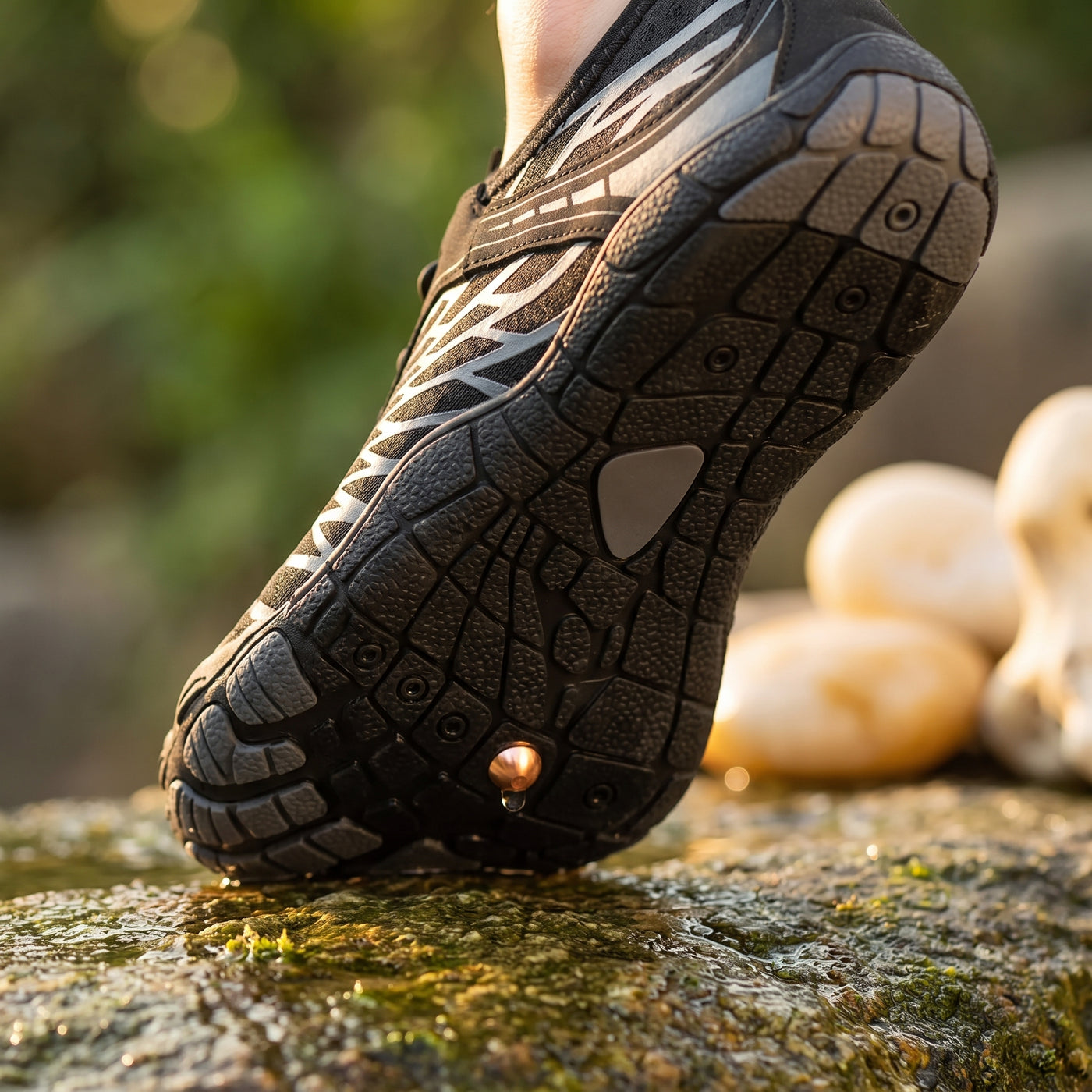
The whole trick, up close: a conductive copper stud in the outsole.
Flip over any barefoot shoe on your comparison list. Rubber, edge to edge. Flip over these and there it is — a bright disc of real copper, connected through to your foot.
Why copper? Because it's the second-most conductive metal on Earth — only silver beats it. There's a reason the entire power grid runs on copper wire. It is simply the best affordable material humans have for moving charge from one place to another. In this case: out of you, into the ground.
Reason 3. You don't have to believe it. You can measure it.

That barefoot-on-grass feeling, measured.
This was the moment for me. In published measurements, grounding the body dropped that stored voltage roughly 70-fold — from over a volt to a few hundredths. It's the same drop you can watch on a $30 voltmeter, on camera, on an ordinary sidewalk.
But the voltage drop is just the signal. Here's what happens downstream — three things the studies kept finding:
Inflammation drops. When you're grounded, electrons flow in and act as natural antioxidants — neutralizing the free radicals that drive chronic inflammation. In a triple-blinded trial of 22 adults, the grounded group's muscle-damage marker rose 310% after hard exercise. The ungrounded group's rose 760%.
Stress settles. In a study of 12 adults grounded for 8 weeks, the body's main stress hormone — cortisol — normalized in its daily rhythm. Not suppressed. Regulated back into its natural pattern.
Blood moves more freely. In a study of 10 adults grounded for just 2 hours, red blood cells were measured at 2.70× more electrically charged on average — meaning they repelled each other instead of clumping. Large clusters fell by more than half. The blood simply flowed better.
Small studies, real journals — and you can read every one on our Science page.
30-day home trial · Free US shipping · Buy 1, Get 1 Free
Reason 4. It grounds you on concrete and pavement — not just grass.
My first thought was: "I'll just walk barefoot in the yard." My second thought was October. Wet grass, gravel, thorns, and a Minnesota winter make actual barefoot time a five-minute novelty.
Concrete and pavement, it turns out, are conductive — they hold moisture. So the copper sole works on the sidewalk, the trail, the parking lot. And unlike the grounding mat a friend keeps by her bed, it isn't an eight-hours-a-night thing you leave at home. Every step of every outdoor errand counts.

- Works on grass, soil, sand, gravel, concrete and pavement
- All day, everywhere — not just at home like a mat
- No bare feet, no weather problem, no five-minute novelty
Reason 5. My first 30 days told me everything.
Days 1–4: Mostly what my old barefoot shoes felt like — toes spreading, calves working, short walks. (If you're new to barefoot shoes, start with 20 minutes a day; there's an adjustment period and the sizing note below matters.)
Week 2: The first thing I noticed wasn't my feet — it was the clock. It was 6 pm and I hadn't thought about my feet yet.
Weeks 3–4: Full errand days. The evening ache that had been my 5 o'clock alarm for three years just… didn't come.
The three pairs on my comparison list
| Wild Barefoot Grounding | Vivobarefoot Motus Strength II | Tolos Soleil | |
|---|---|---|---|
| Wide toe box | ✓ | ✓ | ✓ |
| Zero drop | ✓ | ✓ | ✓ |
| Thin, flexible sole | ✓ | ✓ | ✓ |
| Earth connection | Copper conductive sole | Insulating rubber | Insulating rubber |
| Price | $79.95 (2 pairs, BOGO) | $220 | $115 |
The first three rows are why I trusted the category. The fourth row is why I chose this pair. The fifth row is why I didn't hesitate.
I'm clearly not the only one
★★★★★ 4.9/5 · 12,500+ pairs walking free
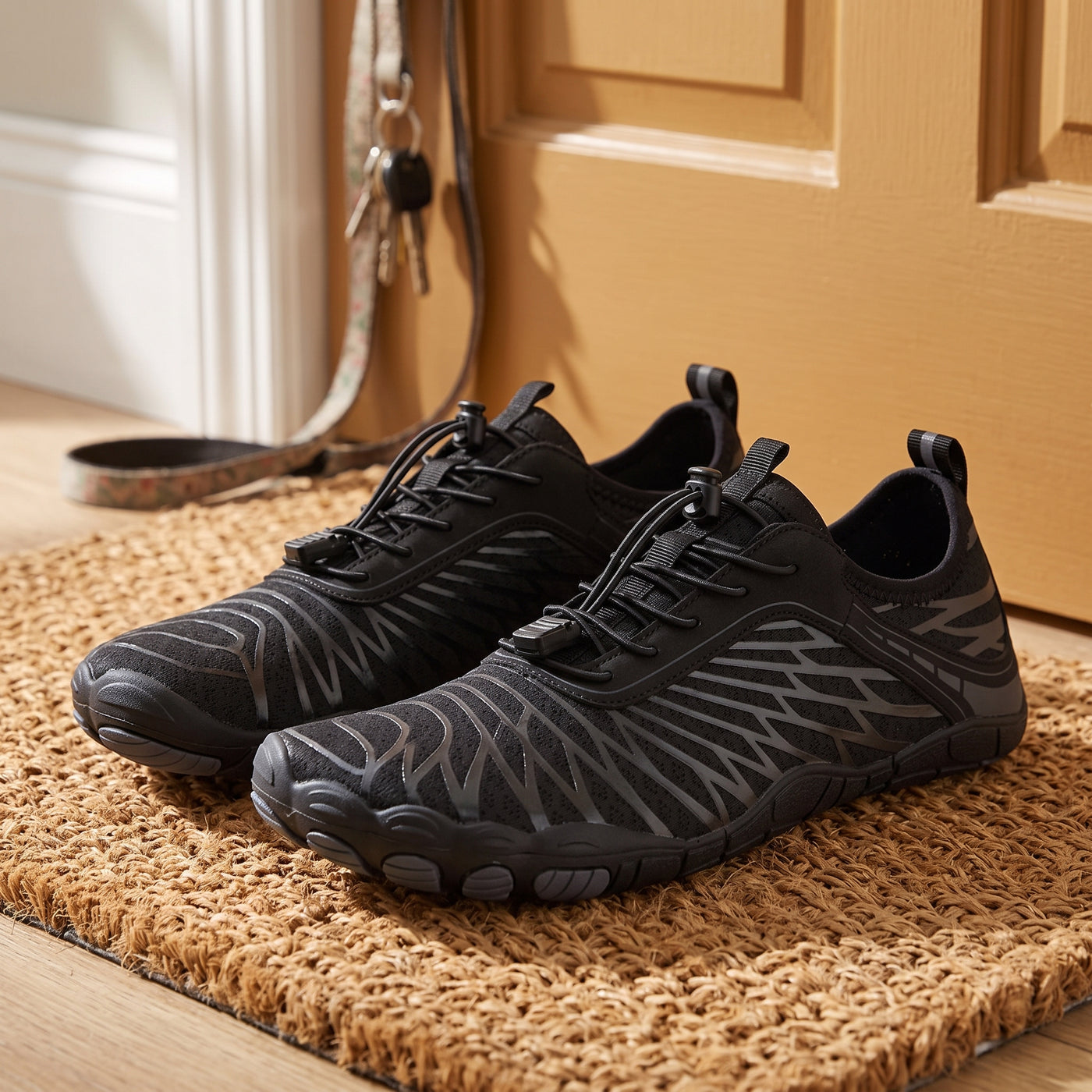
Wild Barefoot™ Grounding Shoes
Barefoot design + copper conductive sole — the only pair on your list that does both.
$79.95 $159.90 · Buy 1, Get 1 Free
- Copper conductive sole · wide toe box · zero drop · featherlight
- 5 colors · women's & men's sizes (W5.5–W14)
- Runs true to size — between sizes? Size up.
Free US shipping · easy exchanges