
Why your feet stil hurts after
Why Your Feet Still Hurt After Buying “Comfort” Shoes — 7 Things to Check Before You Spend Another Dollar
Most people who struggle with tired, aching feet own a drawer full of “comfortable” shoes and insoles. Before you buy the next pair, run these seven 30-second checks — on the shoes you already own.
By the Wild Barefoot team · Updated August 2026 · 7 min read
Here’s the frustrating pattern: you buy shoes marketed as comfortable, they feel nice in the store, and three weeks later your feet ache like before. The problem usually isn’t the cushioning — it’s the shape and structure underneath it. These seven checks make that visible in seconds.
Does the shoe match the shape of your foot?
Feet are widest at the toes. Almost all shoes are narrowest there. That mismatch presses toes together hour after hour — a common source of rubbing, pressure and tired forefeet.
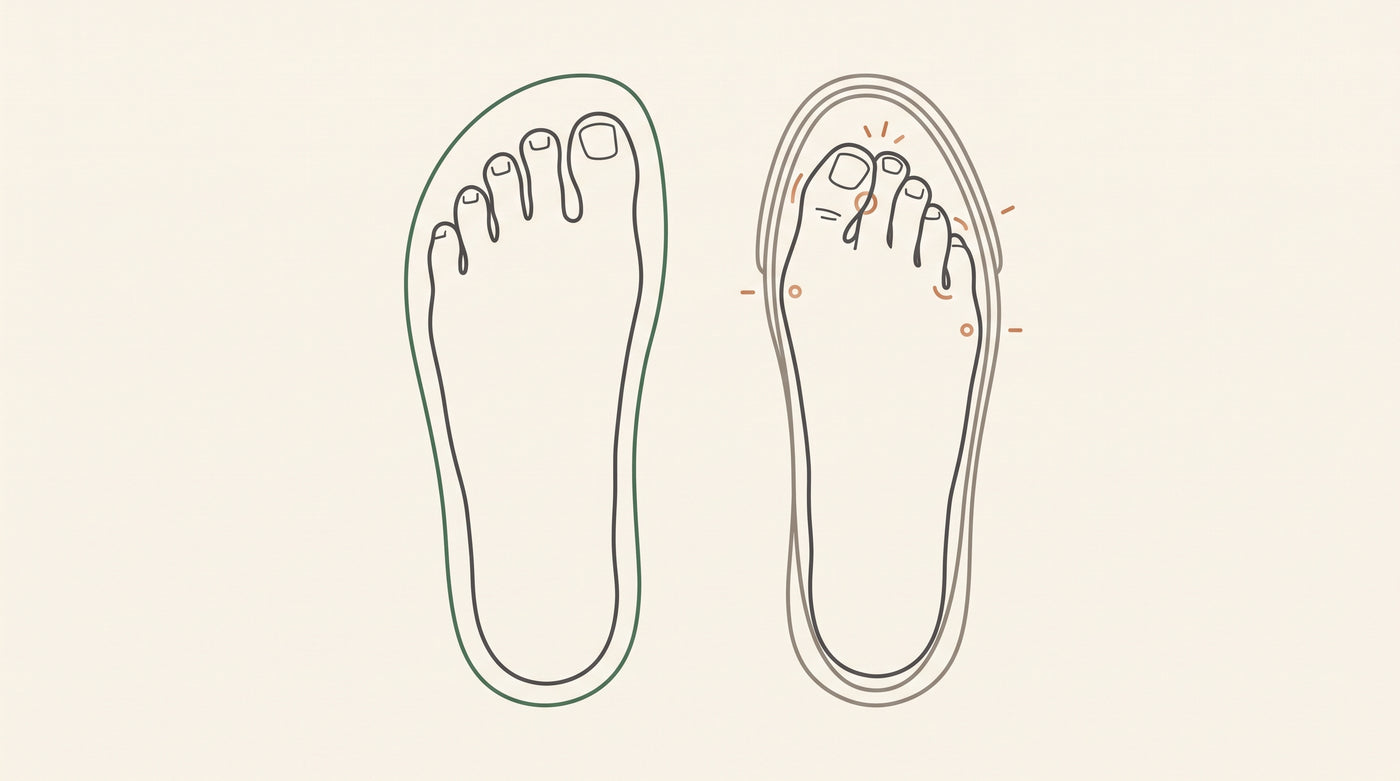
Take out the insole and stand on it. If your toes hang over the edges, your foot spends all day squeezed into a shape smaller than itself.
Is your heel sitting on a hidden wedge?
Even “flat” trainers often raise the heel 8–12 mm above the forefoot. That constant forward tilt changes how load travels through your feet, knees and hips with every step.
Put the shoe on a table and look at it from the side at eye level. Compare the thickness of the sole under the heel with the thickness under the ball of the foot. Equal is rare — and that’s the point.
Can the shoe move the way your foot moves?
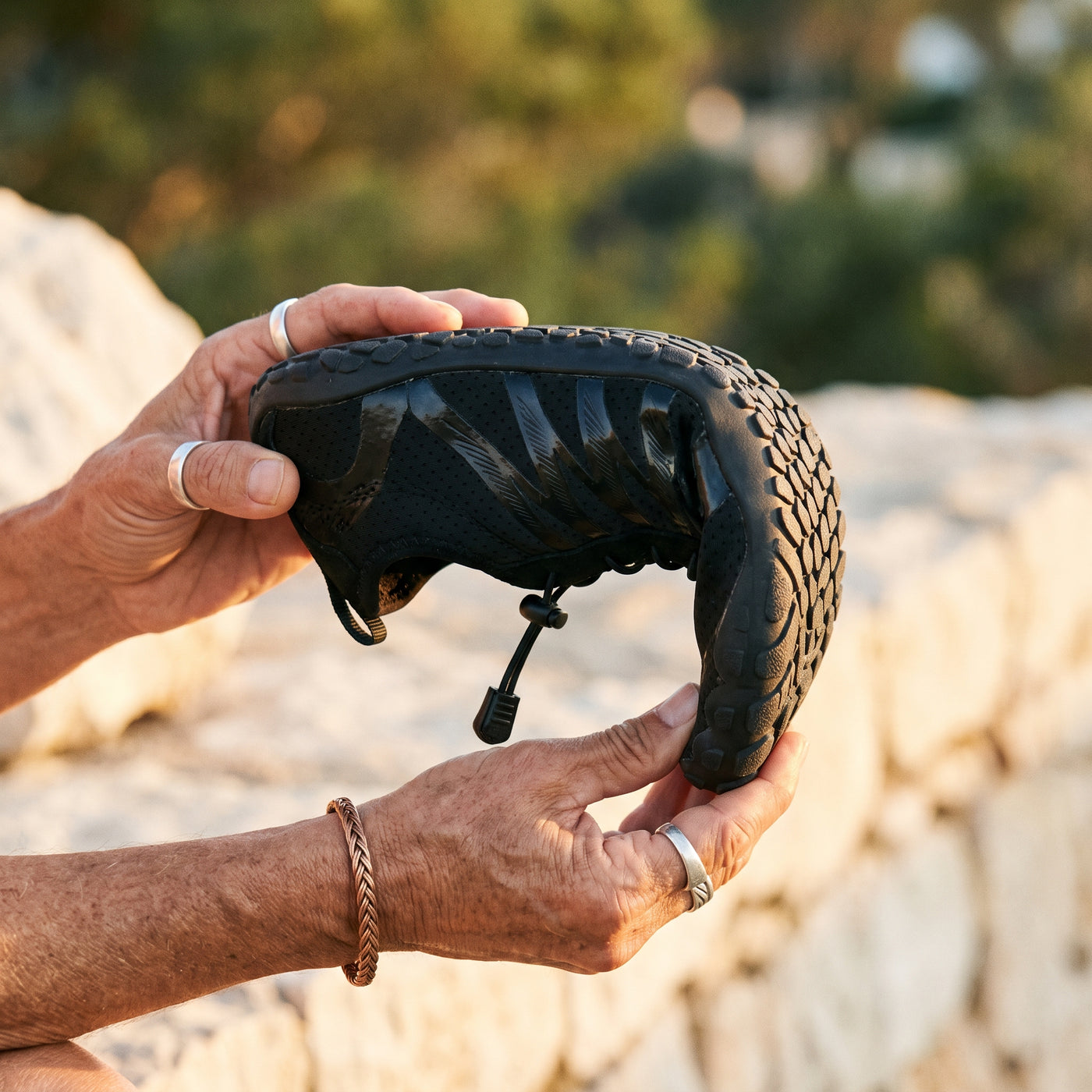
A healthy foot bends and twists constantly as it adapts to the ground. A sole that can’t flex forces the foot to stay rigid inside it — and muscles that don’t move, weaken over time.
Try to bend the shoe toe-to-heel, then gently twist it like wringing a towel. If it barely moves in your hands, it barely moves on your foot.
How much shoe are you lifting all day?
The average person takes 6,000–10,000 steps a day. Every extra 100 grams per shoe is lifted thousands of times — small effort per step, real fatigue by evening.
Kitchen scale. Over ~350 grams for a casual shoe is heavy; under ~250 feels noticeably lighter across a full day. (A typical barefoot sneaker sits well under 250.)
Can you feel anything through the sole?
The soles of your feet are packed with nerve endings that feed your balance system. Thick foam mutes that signal. Many people who feel “unsteady” in cushioned shoes feel noticeably more planted the moment they can sense the ground again.
Stand on a doormat in your shoes, then barefoot. Notice how much information disappears with the shoes on — texture, edges, tilt. That information is what your balance runs on.
Are you buying fixes for a shoe that’s the problem?
Gel pads, arch supports, custom orthotics — they all go inside the same narrow, raised, rigid shoe. Some genuinely help specific issues. But if you’re on your third set of insoles and nothing sticks, the container itself deserves the scrutiny.
- Insoles don’t widen a narrow toe box
- They rarely level a raised heel — many add height
- They can’t make a rigid sole flexible
Test your feet, not another product
The cheapest experiment of all: spend more time genuinely barefoot at home for a week — and notice how your feet respond to moving naturally. If barefoot time feels good, that’s a strong sign your shoes, not your feet, have been the limiting factor.
If you want a shortcut
We build shoes that pass all seven checks out of the box. These two are where most people start:

TerraStride™ Barefoot Sneakers
Our everyday best-seller: wide toe box, zero-drop, ultra-flexible. $79.95 $113.95

Grounding SkinPro™ with Copper Sole
The same barefoot fundamentals, plus a conductive copper sole for outdoor grounding. $89.95 $128.95
Both ship free in the US and can be exchanged or returned within 30 days of delivery — so you can check the fit at home without risk. Curious about the research first? Read The Science of Barefoot →